
Your numbers
for titanic help

+49 2336 808 247
0800-8482648

+49 2336 808 295

+49 2336 808 289

+49 2336 808 350
Contact form
Making the impossible possible? Always.
Our client is an Austrian company with over 8,000 employees across 18 locations worldwide, which produces fibres and pulp from wood. These fibres form the basis for a wide range of textile and non-woven materials. Strapping these rather amorphous fibres requires a fair amount of experience and expertise.
PET strap: a milestone in fibre strapping
Fibres of all kinds are the gold standard in strapping. The fibre itself is extremely stretchy and must therefore be compressed into the desired bale shape in a high-performance press prior to the strapping process. Fibres are also a very delicate material, as a single fibre can break. Traditionally, such fibre bales – whether made of cellulose, cotton or synthetic fibres – have been shaped into the desired form using a press and strapped with steel strap. The transition from steel strap to high-performance PET-strap was a development that had yet to be realised. Steel strap is, by nature, the optimal strapping solution for this application. However, our Austrian customer also produces large quantities for the hygiene sector, meaning that steel must not be present in the fibre bales. Against this backdrop, TITAN introduced PET-strap many years ago as a milestone in the fibre industry. Through joint trials, the correct strapping head and the perfect strap made from PET were identified.
The strapped fibre bales are subject to strict hygiene regulations and are also highly expansive. We were therefore faced with the challenge of finding a strapping solution that not only meets the highest safety standards but is also fully compliant with hygiene requirements.
Manfred Hornaus, Sales Manager at TITAN Austria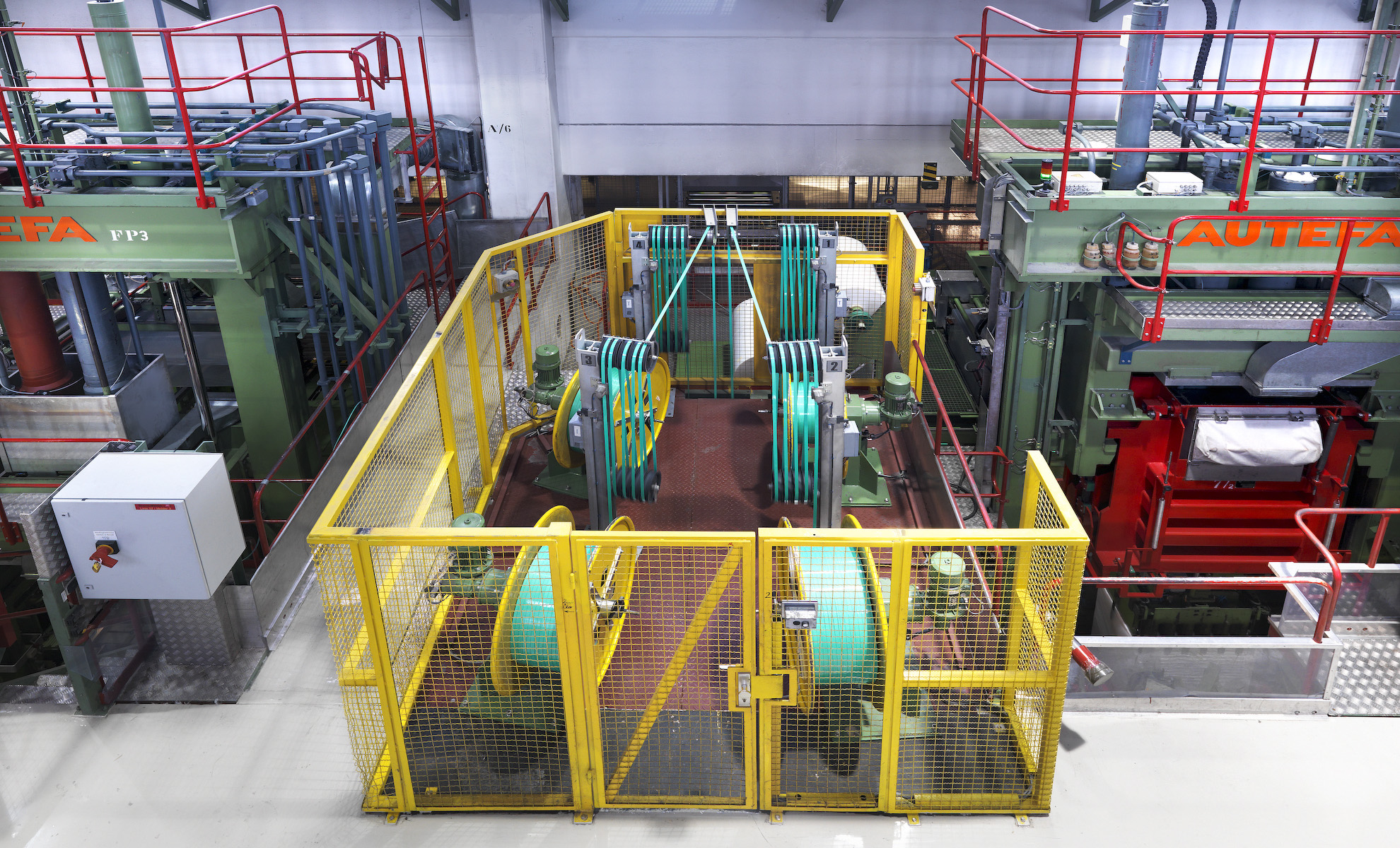
19 mm PET straps can hold 1,400 kg of fibres
To ensure consistent quality, it is necessary to keep the fibre bales of a uniform size. Only then can the number of bales be calculated, taking into account the maximum load capacity of the transport vehicle. The load-bearing capacity of the strap was also a particularly important criterion: as with all products, the strap breaking can pose a major safety risk to the immediate surroundings. At the same time, it is essential to reliably prevent the fibre bale, which is under pressure from the baling process, from bursting open explosively and scattering the pulp throughout the room.
TITAN PET straps provide the solution: with a load capacity of around 1,400 kg, the straps – just 19 mm wide – hold the fibre block securely together. Working closely with the press manufacturers, TITAN has thus succeeded in developing a solution that today ensures consistently safe strapping of fibre bales with film application and labelling for customers worldwide. A happy ending on the fibre production lines!
Did you find
what you were looking for?
Then please do get in touch. Our experts will ask all the right questions and develop a tailor-made strapping solution for you.
Contact