
Your numbers
for titanic help

+49 2336 808 247
0800-8482648

+49 2336 808 295

+49 2336 808 289

+49 2336 808 350
Contact form
The triple bottom line in the strapping industry
Sustainability:
at the Lenzen Gruppe, it’s not just hot (exhaust) air
Straps are also available in sustainable versions – an interview with Peter W. Lenzen
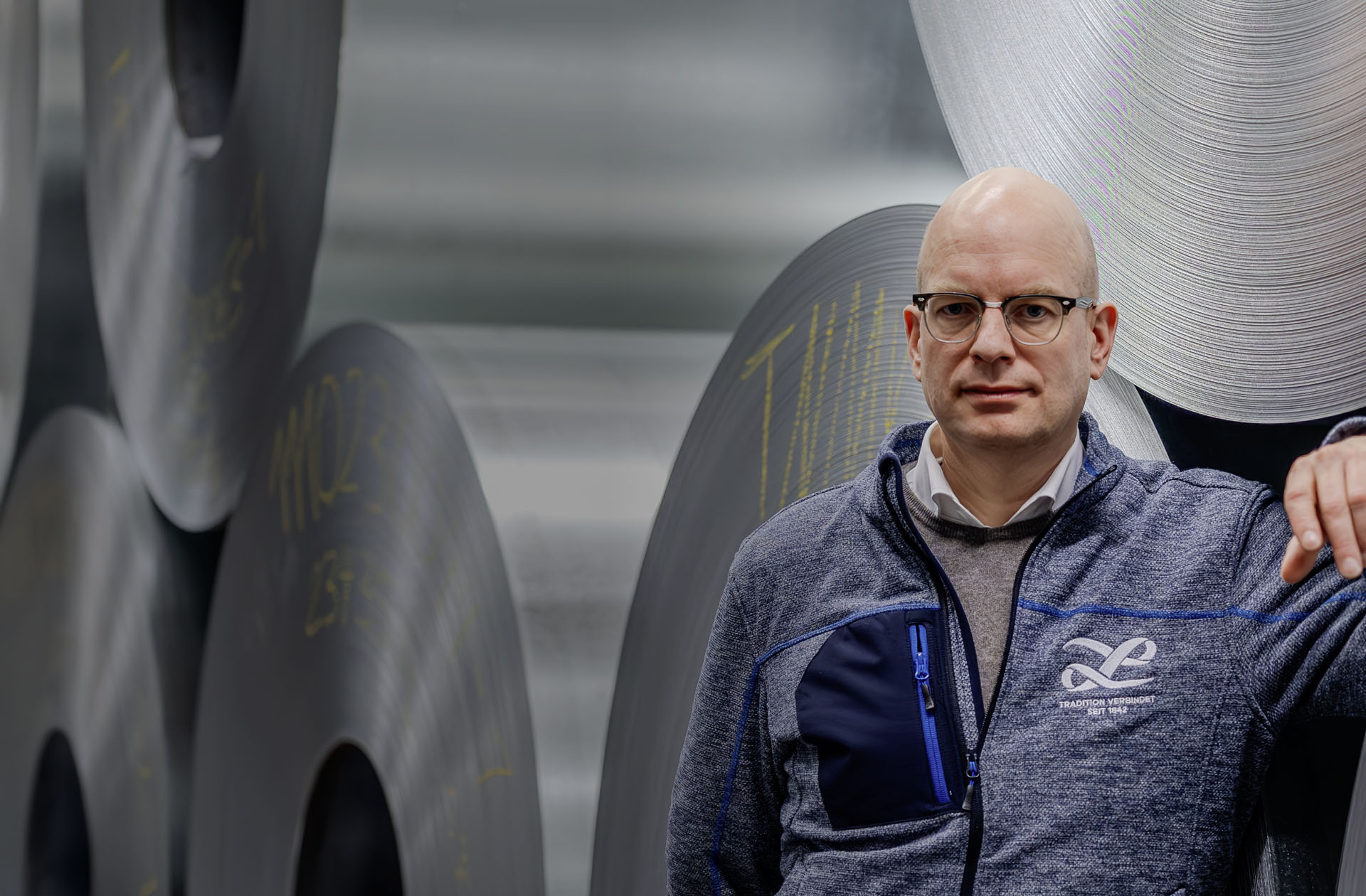
Achieving the triple bottom line – or what ›Kebab Tuesday‹ has to do with sustainability
Sustainability is becoming increasingly important in the packaging industry too. The Lenzen Gruppe, a strapping specialist with five generations of company history, has always operated according to the triple bottom line. This means combining environmental, economic and social aspects to ensure long-term success. Managing Director Peter W. Lenzen emphasises that sustainability is far more than just a buzzword for his company.
Mr Lenzen, could you give us an insight into how the Lenzen Gruppe is integrating sustainability into the strapping industry?
“Sustainability has always played a central role for us. In my view, every company must operate sustainably in order to survive economically in the market. Because sustainability means more than just acting in an environmentally friendly way. That is why we have been running the Lenzen Gruppe for generations in accordance with the ‘triple bottom line’, which combines environmental, economic and social aspects. The intersection of these three areas gives rise to the sustainability we practise. And this is far more than a legal obligation; it is an integral part of our corporate philosophy. This means that we also act proactively to reduce our environmental impact whilst simultaneously taking on social responsibility.”
How do you put the triple bottom line into practice in concrete terms?
“The triple bottom line forms the basis of our sustainability strategy. I see it as a holistic approach to creating long-term value whilst simultaneously having a positive impact on the environment and society. Take the economic aspect, for example: by reducing our consumption of materials and energy, we not only lower our operating costs but also contribute to the company’s competitiveness. By developing a new sealing technology, for example, we have been able to drastically reduce the amount of straps used. We are also a clear industry pioneer in the field of recyclable PET straps. In both cases, the customer’s costs are lower than they were a few years ago. On a social level, we invest in our employees and promote a sustainably positive working environment. In addition to ergonomic workstations, we have, for example, our own in-house gym and offer regular training courses and staff events. Even ›Kebab Tuesday‹, which takes place for everyone at regular intervals, is ultimately a long-term investment in our people.”
How exactly does this sustainability concept manifest itself in the context of strapping production?
“In our production processes, we implement various measures to ensure we operate in an environmentally sustainable manner. One key aspect is the continuous optimisation of our production processes, which helps us minimise resource consumption. For example, we have been using the exhaust air generated in our operations to heat our premises for many years. We are also increasingly using recycled materials, such as in our PET straps, which are made from 99% recycled drinks bottles. This not only conserves resources but also reduces waste.”
How would you rate the importance of sustainability from the customer’s perspective?
“Sustainability is an important issue for our customers too, not least because of the legal framework. We are seeing that larger companies in particular are increasingly looking for sustainable suppliers and setting corresponding requirements. However, economic considerations often take precedence – for many customers, the question of price arises at the same time, as sustainably produced materials such as Green Steel are often associated with higher costs. The challenge here lies in offering sustainable solutions that are also economically attractive.”
In your opinion, what benefits do you think you and your customers will gain from implementing sustainable production?
“The benefits are manifold. On the one hand, efficient production processes enable us to reduce costs and remain profitable in the long term. On the other hand, we distinguish ourselves positively from our competitors and strengthen our market position. Furthermore, we contribute to environmental protection and support the sustainable development of our society. For our customers, this means not only higher product quality, but also a long-term partnership with a responsible supplier.”
How do you see the company’s sustainability goals for the coming years?
“The future of sustainability within our company is closely linked to legal requirements and our internal initiatives. Naturally, we publish an annual sustainability report. To this end, we have implemented software to assist us with documentation. We have also trained an internal employee as a sustainability manager to coordinate this task. A dedicated committee steers and monitors the implementation of our sustainability goals. In this way, we achieve our aim of making our contribution to sustainable development transparent.”
Contact
Lenzen Gruppe
Susanne Peiricks
Tel.: +49 (0) 2336 / 808-250
Email: SP@lenzen-gruppe.de
Website: www.lenzen-gruppe.de